How to Bet on Kalshi: NFL and College Football
Trade NFL and college football on Kalshi: yes vs no contracts, live price swings, limit orders, combos, and the fees that eat your profit.

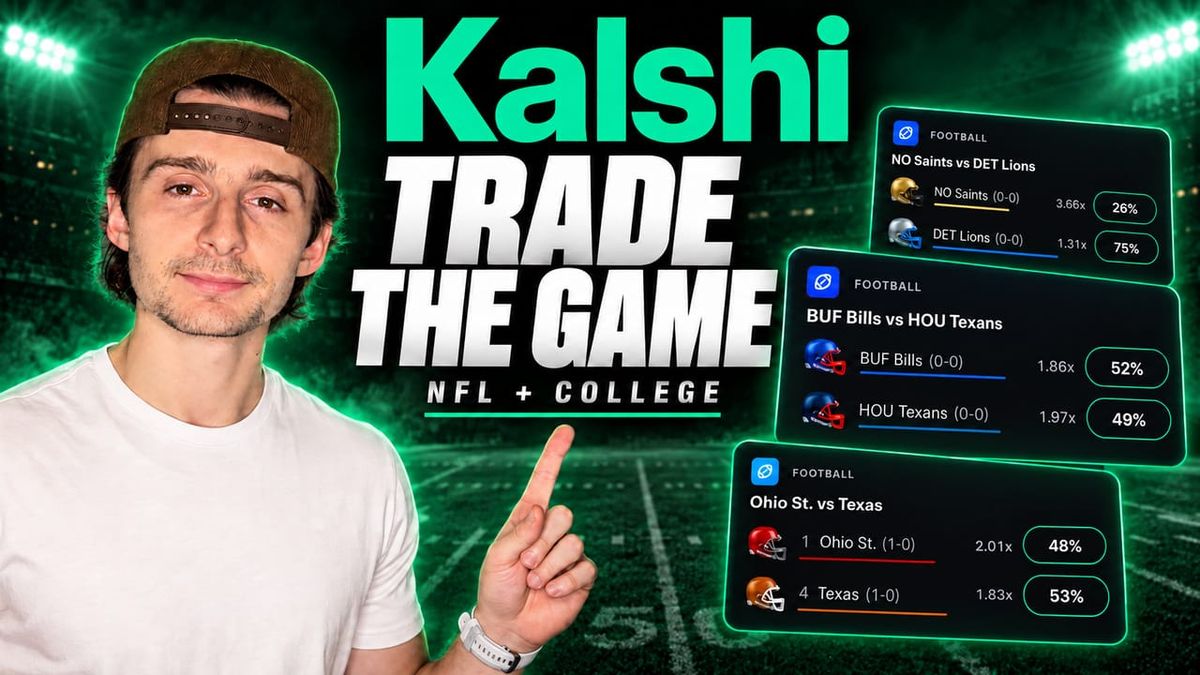
Football season is back, and on Kalshi you can trade games live while they're happening. Buy a position and sell it before the final whistle. Come and go as you please.
That flexibility is genuinely different from traditional sportsbooks. It does not, however, make it easier to make money — and if you learn how to bet on Kalshi without understanding the fee structure first, you can win your trade and still finish down.
This walkthrough covers the NFL and college football markets: what you're actually buying, how prices move during a game, every way to get in and out of a position, and the fees you need to understand before you place a single order.
There are two fee types, and the difference between them is dramatic enough to decide whether a winning trade is actually profitable.
Disclosure: this content is not sponsored by Kalshi and they are not paying for it. The referral link does carry a promotion — sign up through it and trade $25 and you get a $25 bonus, and it pays a bonus on this end too. That's the only monetization here.
Table of Contents
- What You're Actually Buying
- Prerequisites: What You'll Need
- Step-by-Step: Placing Your First Football Trade
- Spreads, Totals, and Team Totals
- Trading Live During a Game
- Fees: The Part That Decides If You Profit
- Combos: Parlays for Prediction Markets
- Payouts and Withdrawal Speed
- Common Mistakes to Avoid
- Tips and Best Practices
- Frequently Asked Questions
- The Bottom Line
Key Takeaways
- You can trade in and out of a game live rather than waiting for it to resolve.
- Every contract settles at either $1 or $0 — correct outcome or nothing.
- Yes on one team and No on the other are the same bet. Pick whichever you find clearer.
- In the NFL regular season, "No" also covers a tie, which "Yes" on the other team does not.
- Dollars and Shares modes are market orders. You fill instantly but pay higher fees and worse prices.
- Limit orders make you a maker — far cheaper fees, but you may never get filled.
- Fees peak at 50 cents, where 100 contracts cost $1.75 as a taker versus roughly $0.44 as a maker.
- Fees apply on both the buy and the sell. A $2 gross profit can become a $1.50 net loss.
- Combos work like parlays and can be cashed out early, unlike a traditional sportsbook parlay.
- Balances often update within 30 minutes of a game ending, with same-day withdrawals possible.
What You're Actually Buying
This is the most important section, because it's genuinely easy to get confused — and the worst outcome is putting $25, $50 or $100 on a market and discovering you bet the wrong thing.
Even after a couple of years using event contracts, it's normal to occasionally pause and double-check what you just placed. The interface is dense. Take the extra ten seconds.
Keeping it as simple as possible: on a game page, the first two lines are just "who wins the game." Not the spread. Not covering anything. Not over or under. Just the winner.
Take a Bills vs. Texans matchup as the example:
- Bills: 51% chance to win the game
- Texans: 49% chance to win the game
Those percentages aren't set by a bookmaker. They come from people putting real money into the market — which is the fundamental difference between a prediction market and a sportsbook.
Yes vs. No: Two Ways to Make the Same Bet
Because both teams are listed, you have two ways to express the exact same view.
If you think the Bills win:
- Buy Yes on the Bills, or
- Buy No on the Texans
These are the same trade at the same price. "No Bills" means the Texans win. "No Houston" means the Bills win.
| Your view | Option A | Option B |
|---|---|---|
| Bills win | Yes on Bills | No on Texans |
| Texans win | Yes on Texans | No on Bills |
Which you choose mostly comes down to personal preference and which framing you find less confusing under pressure. With one exception.
The Tie Loophole
Here's a small edge worth knowing.
NFL regular season games can end in a tie. If they do, "Yes on the Bills" loses — the Bills didn't win. But "No on the Texans" still resolves as a winning trade, because the Texans genuinely did not win.
So when the two prices are identical, the No side quietly covers one extra scenario.
Two caveats:
- In the postseason it doesn't matter — every game must produce a winner.
- College football doesn't have ties. Overtime rules escalate until someone wins. (For a sense of how far that can go, the Penn State–Illinois game a few years back ran to roughly seven overtime periods — likely still the longest by that measure.)
Prerequisites: What You'll Need
- A funded Kalshi account. Connecting a bank account directly makes deposits and withdrawals dramatically faster.
- A small starting stake. The examples here use $5 to $15. Learn the mechanics at a size where mistakes are cheap.
- Roughly 15 minutes for your first trade if you're reading each number properly.
- Desktop or mobile. The web layout is used throughout; mobile is the same structure, just more compact.
- Skill level: beginner-friendly, but this is real money on a market with real spreads and real fees. The fee section below is not optional reading.
Step-by-Step: Placing Your First Football Trade
Step 1 — Find the Football Markets
Log in and you'll see cash and portfolio at the top, plus navigation for markets, perpetuals, live events, Kalshi Pro and more.
You can search for anything directly, but the fastest route is:
- Click the Markets tab
- Go to the Sports tab
- Select NFL or NCAA Football
You'll then see only events tied to that league.
Step 2 — Pick Your Market Type
There's far more available than individual games.
Under NFL:
| Market type | What you're trading |
|---|---|
| Games | Individual matchups |
| Futures | Season-long outcomes, awards, league winner |
| Divisions | Divisional outcomes |
| Fantasy | Top players by fantasy score across the year |
| Player futures | Individual player season outcomes |
| Other events | Specific season events — for instance, next year's number one overall pick |
Under NCAA you get a similar structure, plus the top 25 rankings, sorting by division, conferences, awards, and markets on things like the next AP poll.
That last category gets interesting early. One week into a college season, a market on the following year's number one overall pick can already have a clear favorite.
Step 3 — Read the Win Probability
Open a game and confirm you're looking at the right line. The top two rows are the moneyline equivalent — who wins, nothing else.
The price is the probability. A contract at 52 cents represents roughly a 52% implied chance, and it will pay $1 if correct.
Step 4 — Choose Dollars, Shares, or Limit
Once you've selected a side, the order panel gives you three modes. There's also a one-click submit toggle — leave it off at first so you get a verification step before every order.
Dollars mode is the simplest. Enter what you want to risk:
- Bet $5 on No Texans at 52 cents
- The panel shows the implied odds and, hovering the dollar icon, a 17-cent fee
- Maximum payout: $9.28
Read that payout carefully. $9.28 is what you get back in total, not your profit. You put in $5 and receive $9.28 — just shy of a double.
Shares mode buys a specific number of contracts. Buy 10 shares and you own 10 contracts that the Texans do not win.
The key mechanic: every share resolves to either $1 or $0. Correct outcome, $1 each. Wrong outcome, nothing. (Kalshi maintains rules for unusual situations like a postponed or cancelled game.)
So 10 correct shares means about $10 back, less fees. A worked example: average price 52, cost $5.38 including an 18-cent fee, showing a $4.62 profit if it resolves your way.
Limit mode is where the real savings live, and it deserves its own explanation.
If you've traded stocks, you know the bid-ask spread. A $10 stock might show a $9.99 bid and a $10.01 ask. Prediction markets work the same way:
- Liquid markets have tight spreads — a cent or two at most on a big NFL game
- Illiquid markets widen out — an obscure Thursday night game or a late Saturday matchup between unranked teams nobody's watching
Dollars and Shares modes are effectively market orders. You pay the ask, fill immediately, and in exchange you pay more in fees and don't get the best available price.
A limit order gives you exact price control. With the ask at 52 and the bid at 51:
- Enter at 52 and you'll probably fill right away, because sellers are sitting there
- Enter at 50 and you're below both the bid and the ask — a better price, but it may never fill
That's the real trade-off. If the market never trades down to 50, you simply never get the position. But if you're precise about what you'll pay, and there's a day or more before kickoff, injury news or a starter announcement can easily move price enough to fill you.
Step 5 — Set Your Expiration
Limit orders come with expiration controls:
| Setting | Behavior |
|---|---|
| Good till canceled | Rests until filled or you cancel it |
| Event start | Only fills before kickoff — useful since prices get far more volatile once play begins |
| EOD | Expires at end of day |
| IOC | Immediate or cancel — fill now or don't fill at all |
| Custom | Set your own expiry |
There's also a resting order only option, for when you explicitly don't want an immediate fill.
The event start setting is underrated for football. If your thesis is pregame, there's no reason to leave an order working into the chaos of live play.
Step 6 — Exit the Position
Being able to leave early is the whole point of trading a game rather than betting it.
On any open position you get Buy and Sell options. Selling works the same as buying — sell at market, or set a limit price.
A real example from a Fed rate market that had gone badly: the position was roughly 50/50 and moved sharply the wrong way. Rather than ride it to zero, you can sell part of it.
Selling 50 shares at a 35-cent limit cashes out $17.30 and realizes $8.35 in losses against the overall position. Click review, submit, and with good-till-canceled it either fills or it doesn't.
The event hasn't resolved. There's no decision yet. But you have the option to take profit or cut losses whenever you want — which is exactly what a traditional sportsbook doesn't offer.
Spreads, Totals, and Team Totals
Scroll below the moneyline and you'll find spreads, point totals, and team totals — where things get more interesting if you know what you're doing.
Each shows an order book with the bid-ask spread, and you can toggle between different thresholds rather than accepting one fixed number.
A worked example. The baseline spread might be Bills win by over 1.5 points. But if you're confident they win by ten or more, you can move to Buffalo to win by over 9.5 instead:
- That outcome sits at a 23% chance
- Buy Yes at 23
- Switching to dollars, a $10 bet pays $41.21
That's just north of 1:4 — risking one to make over four on every dollar.
These lines move dramatically as a game progresses, and you can trade in and out of them the whole way.
Trading Live During a Game
How Fast Probabilities Move
The speed catches people off guard. Watching a live event play out, a competitor's win probability can go from 50.5% at 8:31 a.m. to 38.2% at 8:33 — a twelve-point collapse in two minutes, because something happened.
In football, the triggers are constant: a touchdown, a field goal, a turnover, an interception, a punt on fourth and short. Every one of those swings the probabilities.
The Overreaction Opportunity
Here's the structural opportunity live trading creates.
Suppose the Bills were a coin flip against the Texans, and the Texans score first. Does an early field goal genuinely change whether the Bills win the game? Probably not much. But the market will reprice anyway — negative for the Bills, positive for the Texans.
Which means you can now buy the same view you held pregame at a discount.
The same dynamic plays out over a season. Going into week one, the Rams sat around 16–17% to win the Super Bowl. After losing their opener to the 49ers, they dropped to 13%. Not a collapse, but a substantial move off a single game — and they're still favored to make a deep run.
Is that an overreaction? That's the question worth asking, and it's the question that creates the trade. None of this is a recommendation about what to bet — it's a description of the kind of opportunity that exists when markets reprice in real time.
Fees: The Part That Decides If You Profit
This is the section that separates people who make money from people who are technically right and still lose.
Kalshi is not acting as a bookmaker. There's no vig baked into a line — they make their money on trading fees. Which means the fees are explicit, predictable, and entirely within your control.
Maker vs. Taker
| Maker | Taker | |
|---|---|---|
| What you do | Post a limit order others can trade against | Take an order already sitting there |
| Effect on market | Provide liquidity | Remove liquidity |
| Order types | Limit orders that rest | Dollars mode, Shares mode, marketable limits |
| Fill certainty | May never fill | Immediate |
| Fees | Much lower | Much higher |
A taker takes what's available and enters right now — someone is offering a contract, and you accept it. A maker posts a price they're willing to trade at and waits, helping make the market by providing liquidity.
The Fee Curve Peaks in the Middle
Fees on football markets aren't flat. They scale with how uncertain the contract is, and they're highest at 50 cents — the maximum-uncertainty midpoint.
Comparing 100 contracts in college and NFL markets:
| Contract price | Taker fee (100 contracts) |
|---|---|
| 1 cent | $0.07 |
| 50 cents | $1.75 |
| 99 cents | $0.07 |
Those are fees, not the cost of the contracts themselves.
Now the number that matters most. At 50 cents for 100 contracts, the maker fee is roughly $0.44 versus $1.75 as a taker. That's a substantial difference on the identical position.
Other Kalshi markets may use different fee structures — check the current schedule for anything outside college and NFL football.
The Round-Trip Trap
Here's the part that quietly destroys otherwise-winning trades: fees apply on both the buy and the sell.
Work through a trade that looks like a winner:
| Amount | |
|---|---|
| Buy 100 contracts at 50 cents | $50.00 |
| Sell 100 contracts at 52 cents | $52.00 |
| Gross profit | +$2.00 |
| Taker fees, both sides | −$3.50 |
| Net result | −$1.50 |
You called the move correctly. Price went your way. And you still lost $1.50.
This is why limit orders matter so much more here than they do casually trading stocks. If you can be a maker, be a maker — the fee saving is often larger than the edge you were trying to capture. The trade-off remains that you won't always get filled.
Combos: Parlays for Prediction Markets
If you're used to building parlays, there's a Combo button on the page that does something similar.
Add multiple outcomes to your slip, and if all of them happen, the payout multiplies.
A three-leg example:
- No — the Jets will not win
- No — the Texans will not win
- Yes — the Saints will win
All three must hit. A $15 combo on those legs pays out around $21.
Here's where it beats a traditional parlay: you can cash out of a combo at any time, exactly like a single-game position. If two legs have already landed and the third looks strong, you can take money off the table instead of praying.
One realistic limitation: in a complete blowout where your remaining leg is down around a 1% chance, you may struggle to exit — the probabilities are so skewed toward the outcome already being settled that there's little interest on the other side.
Payouts and Withdrawal Speed
Money movement is genuinely fast, which is worth knowing if you've dealt with slow sportsbook payouts.
Your cash and portfolio figures at the top of the account update quickly after games resolve. In practice — across soccer and NFL — balances often adjust within 30 minutes of a game officially ending, sometimes sooner.
That won't be everyone's experience in every situation, but same-day withdrawals are realistic.
One example of how fast it can move: a Falcons preseason game, watched live at the stadium, with a bank account already connected. $150 deposited hit the account instantly. The trade was placed, the trade resolved, the funds were withdrawn — and the withdrawal landed back in the bank before the bank had even logged the original deposit.
That's an unusually clean case, not a guarantee. But if your bank account is connected properly, you're not waiting days or weeks for funds to settle.
Common Mistakes to Avoid
- Betting the wrong line entirely. Confirm whether you're on the moneyline, the spread, or a total before you submit.
- Ignoring the fee structure. A 2-cent winner is a net loser as a round-trip taker. Run the math before you trade small edges.
- Using market orders by default. Dollars and Shares modes are convenient and expensive.
- Reading max payout as profit. A $9.28 payout on a $5 stake is $4.28 of profit, not $9.28.
- Leaving one-click submit on while learning. The verification step exists to catch exactly the mistake that costs you most.
- Taking Yes when No covers more. In NFL regular season, No also wins on a tie.
- Trading illiquid games at market. Obscure late-night college games have wide spreads that quietly cost you on entry.
- Assuming you can always exit. In a blowout, the market for your losing leg can dry up.
Tips and Best Practices
- Default to limit orders. The maker fee saving is the single biggest controllable cost on the platform.
- Use the "event start" expiration for pregame theses so orders don't linger into live volatility.
- Prefer the No side when the price is identical in NFL regular season games, for the tie coverage.
- Check the order book on spreads and totals before choosing a threshold — the alternate lines often have better risk-reward.
- Watch for live overreactions. Early scores move markets more than they change outcomes.
- Start at $5 to $15 until the order panel is completely familiar.
- Connect your bank account directly for the fastest deposits and withdrawals.
- Remember combos can be cashed out early — you don't have to ride a parlay to the end.
Frequently Asked Questions
Can you bet on NFL games on Kalshi?
Yes. Kalshi offers NFL and NCAA football markets covering individual games, spreads, point totals, team totals, futures, divisions, player futures, awards and fantasy-based markets. You can also trade positions live while a game is in progress.
What's the difference between Yes and No on Kalshi?
They're two ways to express the same view. Buying No on one team is equivalent to buying Yes on the other at the same price. The one meaningful difference is that in an NFL regular season game, No also wins if the game ends in a tie.
How do Kalshi contracts settle?
Every contract resolves to either $1 or $0. If your outcome occurs, each share is worth $1; if it doesn't, each share is worth nothing. Kalshi maintains separate rules for unusual situations such as postponed or cancelled games.
How much are Kalshi fees on football markets?
Fees peak at the 50-cent midpoint. For 100 contracts at 50 cents, the taker fee is about $1.75 while the maker fee is roughly $0.44. At 1 cent or 99 cents, taker fees drop to around $0.07 per 100 contracts. Fees apply on both entry and exit.
What's the difference between a maker and a taker on Kalshi?
A taker accepts an existing order and fills immediately, paying higher fees. A maker posts a resting limit order that provides liquidity and pays substantially lower fees, but may never get filled.
Can I sell a Kalshi position before the game ends?
Yes. Any open position can be sold at market or with a limit order at any time before the event resolves, letting you take profit or cut losses early rather than waiting for settlement.
What is a Kalshi combo?
A combo functions like a parlay — you add multiple outcomes to one slip and all of them must occur for it to pay. Unlike a traditional sportsbook parlay, you can cash out of a combo early, though exiting becomes difficult if one leg's probability collapses near zero.
How fast does Kalshi pay out?
Account balances often update within about 30 minutes of a game officially ending, and same-day withdrawals are possible. With a bank account connected directly, deposits can land instantly and withdrawals process quickly.
Is Kalshi a sportsbook?
No. Kalshi is a prediction market, not a bookmaker. Prices are set by participants buying and selling contracts rather than by a bookmaker setting a line, and Kalshi earns revenue through trading fees rather than built-in vig.
Why did my winning Kalshi trade lose money?
Almost always round-trip fees. Buying 100 contracts at 50 cents and selling at 52 produces $2 of gross profit, but $3.50 in taker fees across both sides leaves you down $1.50. Using limit orders to trade as a maker dramatically reduces this.
The Bottom Line
Trading football on a prediction market is genuinely different from betting it. You can enter before kickoff, take profit at halftime, cut a loss in the third quarter, or add to a position when the market overreacts to an early score.
But the flexibility comes with a cost structure you have to respect. The five things that matter most:
- Know exactly which line you're on — moneyline, spread, or total — before you submit
- Understand that every contract settles at $1 or $0, and that max payout includes your stake
- Use limit orders whenever you can and pay maker fees instead of taker fees
- Account for fees on both sides of every round trip before chasing small edges
- Prefer the No side in NFL regular season when prices are equal, for the tie coverage
None of this tells you which teams to trade. It tells you how not to lose money on mechanics before the game even starts — which is where most beginners actually give up their edge.
Ready to try it on this week's slate? Open a Kalshi account here — trade $25 through that link and you'll get a $25 bonus, which is a reasonable way to learn the order panel without risking much of your own money.
Got questions about a specific market or order type? Drop them in the comments on the video.
Watch the full video tutorial here: