My Crypto Trading Bot Turned $300 Into $7,254
A crypto trading bot went from under $300 to $7,254. The leverage, the strategies, and why live forward testing beats any backtest.

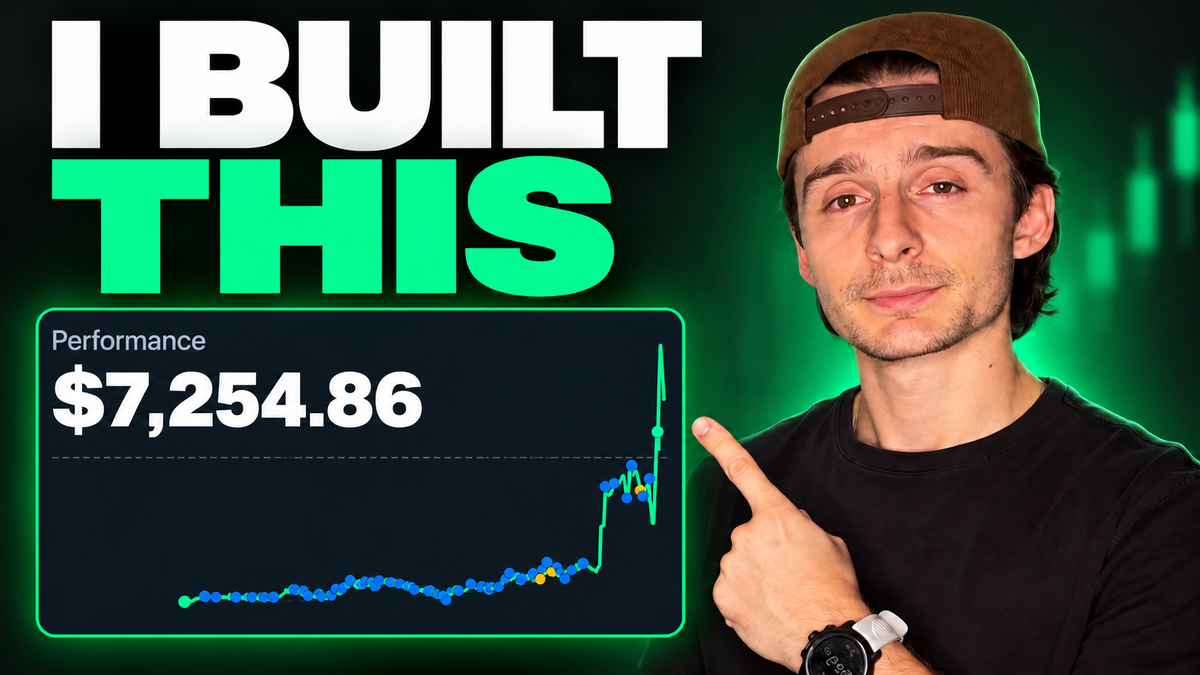
Back in January I built a crypto trading bot and funded it with less than $300. As I write this, that account is worth $7,254.86.
I want to be upfront about three things before anything else. Crypto is in a bull run, and the bulk of those returns landed in the past few weeks and months. I'm running 6x leverage right now, which amplifies everything in both directions. And I run the social media for AlphaInsider, the platform this bot lives on — so you should weigh what follows accordingly.
What I can tell you honestly is that this required very little of my time. I sat back and watched it work for most of the year, touching it only a handful of times. That's the actual point of the exercise.
Here's how the account got here: the platform, the leverage, the strategies that worked, the ones that lost money, and the process I'd repeat.
Table of Contents
- The Results, With Full Context
- The Platform and My Connection to It
- Exchanges and Requirements
- Two Ways to Build a Trading Bot
- Why Live Forward Testing Beats a Backtest
- How TradingView Connects
- My Actual Process
- Allocating Across Strategies
- What Actually Performed
- The Telegram Strategy Experiment
- The Part Nobody Talks About: Not Watching
- Frequently Asked Questions
- The Bottom Line
Key Takeaways
- Under $300 grew to $7,254.86 since January — during a crypto bull run, at 6x leverage.
- Leverage is doing a lot of the work. Without it, these returns wouldn't be possible, and the downside scales identically.
- A backtest that looks perfect often trades badly in reality. Forward testing on live data is the only real validation.
- Trade history on the platform can't be edited by the strategy creator — if a strategy performs badly, that stays visible.
- Plenty of my own strategies lost money. That's useful information you only get by running them live.
- Diversify across multiple strategies with percentage allocations rather than betting everything on one.
- Look for many trades and consistent multi-year returns, not one lucky Bitcoin run.
- AI can now build strategies for you via an installable skill on ChatGPT, Claude or Grok.
- The real benefit is not watching. No daily pressure to make money, no staring at charts.
- When you don't trust the setup, drop the leverage or go to cash. Doing nothing is a valid position.
The Results, With Full Context
The headline number is real: less than $300 in January, $7,254.86 now. But a number without context is close to useless, so here's the full picture.
I currently run two active trading bots, both rebalancing positions as I write this:
| Bot | Exchange | Starting capital | Current value |
|---|---|---|---|
| Main bot | Hyperliquid | Under $300 | $7,254.86 |
| Newer bot | Lighter | $200 | Just under $300 |
The second bot is brand new and holds two positions — one strategy plus my own TC Bot strategy. Most of my capital sits in the first one, but I've started adding to the second purely to diversify.
The account did not go straight up. There were a lot of ins and outs, plenty of different strategies deployed, and slow, incremental growth for months before crypto ran.
What the Leverage Is Actually Doing
I'm on 6x leverage as I write this, and that number has moved up and down all year.
The account bounces around dramatically because of it — a lot of underlying positions moving aggressively in both directions. Without access to that leverage, these returns simply would not be possible.
That cuts both ways, and it's the single most important caveat in this entire article. Leverage is why the number is $7,254 rather than something far more modest. It's also why the same account could give a large portion of that back.
Monitoring the leverage is most of my active involvement now. When I'm less confident, I bring it down.
The Bull Run Caveat
Crypto is in a bull run, and the bulk of these returns came in the past few weeks and months.
Is this a real move, or a false pop before a bigger drawdown? I genuinely don't know, and nobody can guarantee either. Anyone telling you otherwise is guessing with more confidence than the situation allows.
What I'd point to instead is the part that isn't market-dependent: the account grew slowly but consistently before the run, across a lot of different strategies, without me watching it.
The Platform and My Connection to It
All of this runs on AlphaInsider.
Full disclosure: I run the social media for AlphaInsider. That's exactly how I got pulled into the automation side of trading in the first place. A year ago I wasn't thinking about any of this — I was manual swing trading, which doesn't demand much time, but wasn't automated in any way.
I'd rather state that connection plainly than have you find it out later. Weigh the recommendation with that in mind.
For what it's worth, I've also been building automations elsewhere — including a Kalshi trading bot I covered recently, with an update coming.
Exchanges and Requirements
Creating a bot starts with clicking New and choosing where it trades:
| Asset class | Available exchanges |
|---|---|
| Stocks | Alpaca |
| Crypto | Hyperliquid, Lighter, Binance |
Hyperliquid and Lighter are the standouts for this use case. No KYC, a $100 minimum deposit, and access to substantial leverage — which, as covered above, is what makes this kind of return profile possible at all.
One significant limitation: these platforms aren't accessible everywhere. If you're in the United States or certain other jurisdictions, access is restricted. That's a real constraint you need to check against your own location before planning around these exchanges.
There does appear to be movement toward getting platforms like Hyperliquid fully regulated in the United States, but that's a future possibility rather than a current state.
Two Ways to Build a Trading Bot
There are two approaches, and neither is better than the other. It comes down to preference, and most people end up blending them over time.
Path One — Follow Proven Strategies
If you're starting out, building strategies from scratch is genuinely challenging. The alternative is the strategy marketplace.
Sort by top crypto strategies and you can see what's actually performing, then autotrade any of them in your own bot. You're allocating capital to someone else's logic, but the execution is automated and under your control.
This is the fastest path from zero to a running bot.
Path Two — Build Your Own With AI
Building custom strategies has gotten dramatically easier, and this is the part that genuinely changed in the past year.
You install a skill from AlphaInsider's API docs onto ChatGPT, Claude, Grok, or whichever AI platform you use. From there you build a strategy by vibe coding it — the AI asks you questions, you describe what you want, and you converge on something concrete together.
It produces a backtest, and then you bring the strategy live into your portfolio.
The honest part: my portfolio contains a lot of test strategies, and plenty of them are bad. They lose money. Some of them lose a lot of money.
That's actually the value. Now I know not to use them — and I wouldn't have known until I watched them trade live.
Why Live Forward Testing Beats a Backtest
This is the concept that matters most in the whole article.
When a strategy is in your portfolio, the platform tracks every trade it fires on live data. Think of it as live paper trading — not replaying past data, but evaluating against the market as it actually moves right now.
Why this matters: you can have a backtest that looks amazing on paper. I've produced dozens of them. Beautiful equity curves, perfect entries.
And then it trades badly in reality. A lot of my strategies do exactly that.
The gap between a backtest and live performance is where most retail automation dies. Forward testing on live data is the only thing that closes it, and it costs you nothing but time.
The Trade History Cannot Be Edited
Here's a structural detail that makes the marketplace far more trustworthy than it would otherwise be.
Once a trade is sent in, it's tracked, logged, and permanent. The strategy creator has no way to edit it. There's no quiet deletion of a bad month, no "sorry guys" revision.
If a strategy performs badly, that stays visible forever.
The result is an honest leaderboard. A lot of what's on there isn't good — and you can see that it isn't good. The handful that float to the top have genuinely earned it against an unforgiving record.
How TradingView Connects
Most of my strategies originate on TradingView, and the bridge between the two platforms is a webhook.
On a TradingView strategy, click the three dots, choose Add alert, and create a webhook that sends to AlphaInsider. Every time that strategy fires, the trade gets sent over, tracked and verified.
Here's a concrete example of why that matters. I have a Bitcoin strategy on TradingView called Swing Lab. The backtest goes back to 2016 and looks genuinely perfect — clean, beautiful, exactly what you'd want to see. It also only trades a couple of times per year.
In my account it hasn't taken a single trade yet. But every future signal it produces will be logged, so eventually I'll have real evidence instead of a backtest.
That verification layer is the biggest value add of the whole system, more than the marketplace itself.
My Actual Process
Five steps, repeated:
- Build the strategy — on TradingView, or now with AI through the installable skill
- Get the backtest. It usually looks great. This proves nothing yet.
- Run it live on the platform so every signal is tracked against real market data
- Wait for enough data to confirm it trades the way you envisioned — or the way the backtest suggested
- Click Autotrade and add it to a bot with a specific allocation
Step four is the one people skip, and it's the one that separates a strategy you believe in from a strategy you hope about.
Allocating Across Strategies
A bot doesn't run one strategy. It runs a portfolio of them, each with a percentage of the account.
Adding a strategy is straightforward: set its allocation, adjust the others so the total works, and save. The bot rebalances automatically and shows you each strategy alongside its share of capital.
A worked example from my newer bot: add Swing Lab at 10%, drop an existing strategy to 10%, and leave the remaining 80% with the third.
That's three different strategies, trading different things, with different capital weights — all inside one automated bot. Diversification at the strategy level, not just the asset level.
This is essentially what I did all year: allocate, observe, reallocate.
What Actually Performed
My Own Strategies
Two of mine carried most of the load:
| Strategy | Year-to-date | Notes |
|---|---|---|
| Stealthy 7 Linear Regression | +119% | Weak start to the year; strong since late March / early April |
| TC Bot | +118% | My semi-manual Telegram strategy — more aggressive |
A few others in my portfolio are starting to look promising: a Tesla extended weekend strategy, a 200 SMA Plus strategy, and a volume squeeze breakout strategy I find genuinely interesting. Several more are still gathering data.
My top crypto strategy actually ranks third on the public leaderboard — but I keep it private. Partly because it's risky, and partly because if I have a real edge, I'd rather not hand it over and watch it decay.
Public Strategies Worth Watching
Some public strategies have outperformed anything I've done manually. Two TradingView-sourced strategies are up over 125% on the year alone.
Two others I've watched closely, both valuable for the same reason — consistency over years, not one spectacular run:
| Strategy | This year | Longer term |
|---|---|---|
| Bitcoin and Ethereum Long (by Filipina) | ~+50% | +243% over the past three to four years |
| Tim Wave Trend | ~+50% | +240% over five years |
I've had the first one in my bot at times. The second actually produced one of the earliest big jumps in my account — a 50% to 75% move — and while it's not in the bot right now, it remains one of the most solid performers I've tracked.
The standard caveat applies and deserves stating plainly: none of this guarantees future performance. History and track record are all anyone has to work with.
What I Look For in a Strategy
When I'm evaluating anything on the leaderboard, three things:
- A high number of trades. More trades means more data, and more data means the result is less likely to be luck.
- A long, consistent history. Multi-year returns that hold up across different market conditions.
- Not one lucky trade. A strategy that bought Bitcoin once, rode it up, and stopped is not a strategy — it's a coincidence with a chart.
That third point filters out a surprising amount of what looks impressive at first glance.
The Telegram Strategy Experiment
My TC Bot strategy works differently from the rest, and it's worth explaining because it shows how flexible the system is.
I connected a Telegram channel directly to a trading strategy. Now I just message that channel — often by voice — with things like "I want to get into Ethereum," "increase my Bitcoin position by this much," or "decrease this position."
I get a confirmation message back, and the strategy adapts its positions accordingly.
From there it branches:
- If the strategy is connected to a live bot → it executes the trades
- If it isn't → it logs the positions so you can track how the strategy would have performed
Being honest about what this is: it's up 118%, and I'm running it semi-manually with leverage on top. That combination makes anyone look like a genius in a bull market. The performance is real, but so is the context.
The Part Nobody Talks About: Not Watching
The returns are the headline. The actual benefit has been not thinking about it.
I'm not sitting there stressed about my account, feeling like I need to make money today to keep compounding. That pressure is what pushes people into oversized positions and revenge trades.
Instead: I trust what I'm in, and I let it ride.
And when I don't trust it, I have simple options:
- Drop the leverage
- Go mostly to cash
- Leave it alone entirely
If I'm in strategy development and don't have anything I feel genuinely good about, I don't force a position. Doing nothing is a completely valid state, and it's far easier to accept when a system is running rather than when you're staring at charts looking for something to do.
The time savings alone would justify the setup. The fact that it removed the emotional pressure too is what's made it stick.
Frequently Asked Questions
How much did the crypto trading bot start with?
Under $300, funded in January. It's currently worth $7,254.86. A second, newer bot started at $200 and now sits just under $300.
How much leverage is the bot using?
6x at the time of writing, though that's moved up and down throughout the year. Without leverage these returns wouldn't be achievable — and the downside scales in exactly the same proportion.
Which exchanges can you connect?
Alpaca for stocks, and Hyperliquid, Lighter or Binance for crypto. Hyperliquid and Lighter require no KYC and have a $100 minimum deposit, but they aren't accessible in every jurisdiction, including parts of the United States.
Do I need to know how to code to build a trading strategy?
No. You can install a skill from AlphaInsider's API docs onto ChatGPT, Claude or Grok and build a strategy conversationally — the AI asks questions, you describe what you want, and it produces a backtest.
What's the difference between a backtest and forward testing?
A backtest runs your logic against historical data. Forward testing runs it against live market data as it happens. A backtest can look perfect and still trade badly in reality, which is why live tracking before committing capital matters.
Can strategy creators edit their trade history?
No. Once a trade is sent in, it's tracked and logged permanently. Creators cannot delete or revise bad results, which makes the public performance leaderboard considerably more trustworthy.
How do you connect TradingView to a trading bot?
On your TradingView strategy, open the three-dot menu, choose Add alert, and set up a webhook pointing to AlphaInsider. Every signal the strategy fires is then sent over, tracked and verified.
How many strategies should a bot run?
More than one. Allocations are set by percentage, so you can split a bot across several strategies — for example 80%, 10% and 10% — and diversify at the strategy level rather than concentrating in a single approach.
What should I look for when choosing a strategy to follow?
A high trade count, a long and consistent history, and returns spread across many trades rather than one lucky move. A strategy that made its gains on a single Bitcoin run isn't demonstrating an edge.
Is a trading bot passive income?
Not exactly. It removes daily screen time and emotional decision-making, but you still monitor leverage, review strategy performance and decide when to reduce exposure. The work shifts from executing to overseeing.
The Bottom Line
Under $300 became $7,254.86 across roughly nine months, with very little of my time. That's the real result, and it came with real caveats: a crypto bull run, 6x leverage, and my own professional connection to the platform.
What's transferable isn't the number — it's the process:
- Build strategies on TradingView or with AI, and expect most of them to be bad
- Forward test on live data before committing a dollar, because backtests lie
- Diversify across strategies with percentage allocations, not one big bet
- Look for trade count and multi-year consistency, not one spectacular run
- Manage leverage deliberately, and go to cash when nothing looks good
The thing I keep coming back to is how little attention it required. I'm not claiming this replaces understanding markets — leverage will punish you just as efficiently as it rewards you. But having a system that runs while you work, with a permanent record of what actually performed, is a genuinely different relationship with trading than staring at charts hoping to catch something.
I'll keep sharing updates on this bot and the new one as they develop.
If you want to look at the strategy leaderboard yourself, or start forward testing something before you risk capital on it, you can explore AlphaInsider here — even just watching a strategy trade live for a few weeks teaches you more than any backtest will.
Watch the full video tutorial here: